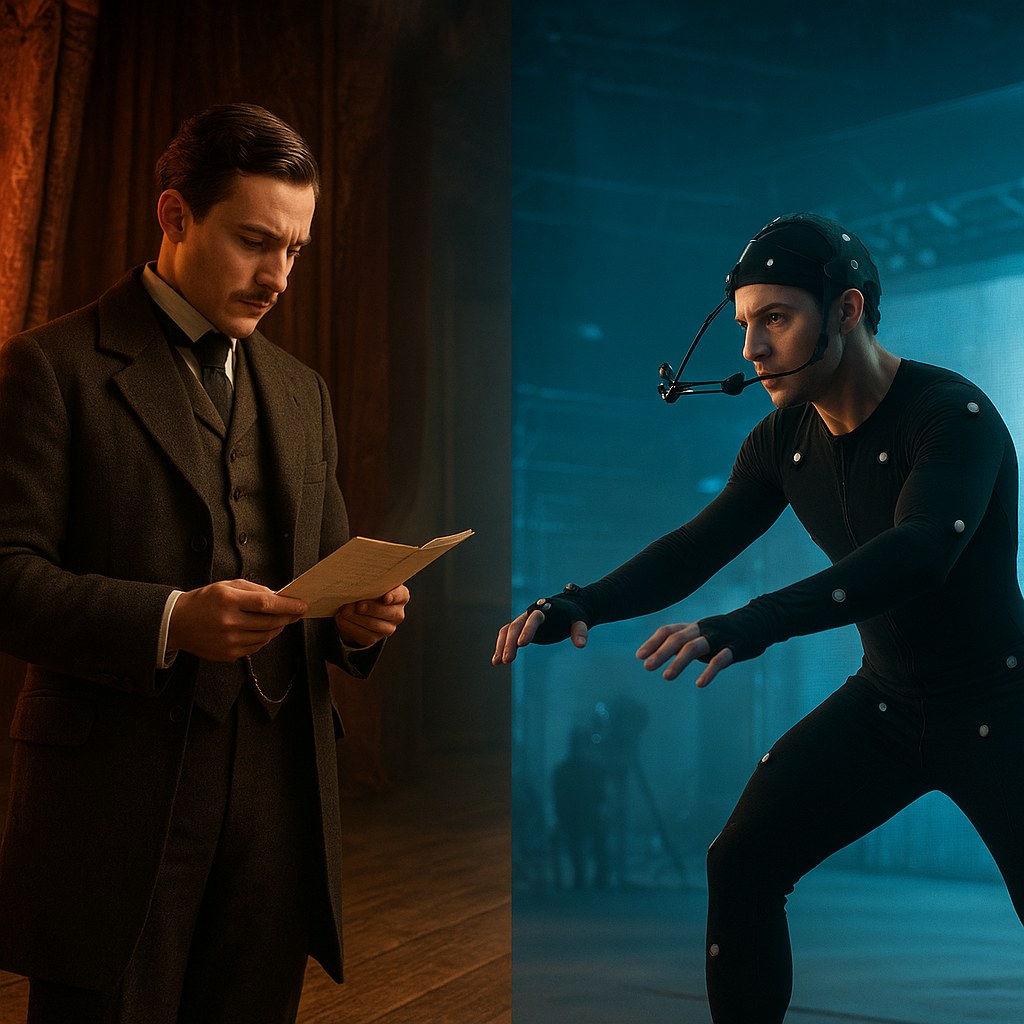
How Method Acting Evolved from Stanislavski to Modern Cinema
Explore the evolution of method acting in modern cinema, from Stanislavski’s groundbreaking techniques to today’s immersive performances. Discover how actors tr
For nearly a century, method acting has shaped how performers approach their craft, transforming cinema from theatrical gestures into raw, psychologically complex portrayals. What began as Konstantin Stanislavski’s revolutionary system in early 20th-century Russia evolved into a distinctly American technique that would produce some of Hollywood’s most celebrated—and controversial—performances. Today, the method continues to spark debate among actors, directors, and audiences who question whether emotional authenticity requires personal sacrifice.
This exploration traces the technique’s journey from Moscow rehearsal rooms to modern film sets, examining how each generation of actors has adapted, rejected, or reinvented Stanislavski’s vision to suit the demands of contemporary cinema.
The Stanislavski System: Foundations of Emotional Truth
Konstantin Stanislavski developed his system at the Moscow Art Theatre in the early 1900s, seeking to move beyond the declamatory acting styles that dominated 19th-century stages. Rather than relying on stock gestures and vocal tricks, Stanislavski proposed that actors draw upon their own emotional memories and psychological truths to create authentic characters.
His approach centered on several key concepts that would later form the backbone of method acting:
- Emotional memory: Actors recall personal experiences to generate genuine feelings on stage
- The “magic if”: Performers ask themselves how they would behave if they were in the character’s circumstances
- Given circumstances: Detailed analysis of the character’s background, environment, and relationships
- Physical actions: The belief that physical behavior triggers emotional responses
Stanislavski emphasized rigorous research and preparation, encouraging actors to observe real people and immerse themselves in their character’s world. His 1936 book An Actor Prepares became the foundational text for generations of performers, though many Western interpretations would later diverge significantly from his original teachings.
The American Transformation: From System to Method
When Russian émigré Richard Boleslavsky began teaching Stanislavski’s techniques in New York during the 1920s, he planted seeds that would grow into something distinctly different. The Group Theatre, founded in 1931 by Harold Clurman, Cheryl Crawford, and Lee Strasberg, became the laboratory where American method acting truly took shape.
Lee Strasberg and the Actors Studio
Lee Strasberg, often called the father of method acting in America, adapted Stanislavski’s system with an intense focus on psychological exercises. At the Actors Studio, which he led from 1951 until his death in 1982, Strasberg pushed actors to explore their own traumatic memories and personal demons as fuel for their performances.
Strasberg’s version emphasized what he called “affective memory”—deliberately accessing painful or powerful emotional experiences to achieve authentic feeling on camera. This approach produced remarkable results but also attracted criticism for potentially damaging actors’ mental health. Elia Kazan, who directed many method actors, once noted that Strasberg’s techniques worked best for performers with “a certain kind of emotional availability.”
Stella Adler and Sanford Meisner: Alternative Paths
Not all American teachers followed Strasberg’s psychological intensity. Stella Adler, who actually studied with Stanislavski in Paris, rejected the emphasis on personal emotional recall. She argued that imagination and deep understanding of the character’s circumstances created more sustainable and truthful performances. Adler famously told her students, “Your talent is in your imagination,” not in dredging up personal trauma.
Sanford Meisner developed yet another approach at the Neighborhood Playhouse, focusing on “living truthfully under imaginary circumstances” through repetition exercises and spontaneous reaction. His technique prioritized authentic interaction with scene partners over internal emotional excavation.
These three teachers—Strasberg, Adler, and Meisner—created the primary branches of American method training, each producing legendary actors who would dominate mid-century cinema.
The Golden Age: Method Acting Transforms Hollywood
The 1950s marked method acting’s explosive arrival in mainstream cinema. Marlon Brando’s raw, naturalistic performance in A Streetcar Named Desire (1951) announced a new era. His mumbled delivery, physical intensity, and psychological complexity contrasted sharply with the polished, theatrical styles of established Hollywood stars.
James Dean brought method sensibilities to teenage alienation in Rebel Without a Cause (1955), while Montgomery Clift had already demonstrated the technique’s power in A Place in the Sun (1951). These actors created characters with unprecedented psychological depth, making older performance styles seem artificial by comparison.
The method’s influence extended beyond individual performances. Directors like Elia Kazan and Martin Ritt specifically sought method-trained actors for their ability to improvise, take risks, and deliver unpredictable, emotionally charged work. By 1960, method acting had become synonymous with serious, prestigious film performance.

Modern Evolution: Daniel Day-Lewis and Contemporary Approaches
While method acting never disappeared, its techniques evolved significantly in the late 20th and early 21st centuries. Daniel Day-Lewis emerged as the technique’s most famous—and extreme—modern practitioner, raising fundamental questions about the cost of immersive preparation.
What is Daniel Day-Lewis’ Method of Acting?
Day-Lewis’s approach represents method acting taken to its logical extreme. For My Left Foot (1989), he remained in character as Christy Brown throughout production, insisting on being carried and fed by crew members. During The Last of the Mohicans (1992), he lived in the wilderness, learning to hunt and build canoes. For Lincoln (2012), he maintained the president’s voice and mannerisms for months, texting co-stars in character.
His process involves:
- Total immersion: Remaining in character between takes and often throughout entire productions
- Physical transformation: Radical changes to his body, voice, and movement patterns
- Research obsession: Months or years studying historical figures, skills, and environments
- Isolation: Limited contact with family and normal life during filming
Day-Lewis has won three Academy Awards for Best Actor—a record for male performers—suggesting the method’s continued effectiveness. However, he has also spoken about the technique’s toll, announcing his retirement in 2017 partly due to the psychological demands of his process.
The New Generation: Adaptive Methods
Younger actors have largely adopted more flexible approaches, blending method techniques with other training. Joaquin Phoenix’s transformation for Joker (2019) involved significant weight loss and psychological research, but he maintained clear boundaries between himself and the character. Heath Ledger’s Joker in The Dark Knight (2008) combined method immersion with technical precision, though the role’s intensity preceded his tragic death.
Contemporary method practitioners often emphasize sustainable practices. Many now work with acting coaches who help them enter and exit characters safely, recognizing that Strasberg’s most intense techniques risked psychological harm without necessarily improving performances.
Famous Method Actors and Their Techniques
Beyond Day-Lewis, numerous acclaimed actors have built careers on method foundations:
- Robert De Niro: Gained 60 pounds for Raging Bull (1980), drove taxis for Taxi Driver (1976), and learned boxing, Italian dialects, and time-period skills for various roles
- Al Pacino: Studied with Strasberg and brought method intensity to Serpico (1973) and Scarface (1983)
- Meryl Streep: Though she rejects the “method” label, her research-intensive preparation and accent work reflect method principles
- Christian Bale: Famous for extreme physical transformations, losing 63 pounds for The Machinist (2004) and gaining muscle for Batman Begins (2005)
- Charlize Theron: Underwent dramatic physical changes and psychological preparation for Monster (2003)
These performers demonstrate how method techniques have diversified. Some focus on physical transformation, others on psychological immersion, and many combine multiple approaches based on each role’s demands.
What is the 3 Actor Rule?
The “3 actor rule” isn’t a formal technique but rather an informal guideline some casting directors and acting teachers reference. It suggests that for any significant role, productions should audition or consider at least three actors representing different approaches or types. This practice acknowledges that method acting represents just one path to compelling performance.
The rule implicitly recognizes that technical actors, classical performers, and method practitioners each bring distinct strengths. Some roles benefit from method immersion, while others require the precision of technical training or the spontaneity of Meisner technique.
Who Pioneered Method Acting?
While Stanislavski created the foundational system, Lee Strasberg most directly pioneered what Americans call “method acting.” His adaptation emphasized psychological exercises and emotional memory that distinguished the method from Stanislavski’s later, more physically focused teachings.
However, credit belongs to a broader community: Stella Adler and Sanford Meisner developed alternative methods; Elia Kazan proved their cinematic effectiveness; and actors like Brando and Dean demonstrated their power to mass audiences. The method emerged from collective experimentation rather than any single innovator.
Criticisms and Controversies: Is Method Acting Good?
Method acting faces substantial criticism from multiple directions. Some directors argue it creates self-indulgent performances that serve actors rather than stories. Laurence Olivier famously dismissed method techniques when working with Dustin Hoffman on Marathon Man (1976), asking, “Why not try acting?”

Mental health concerns represent the most serious criticism. Strasberg’s emotional memory exercises risked retraumatizing vulnerable performers. Several actors, including Adrien Brody and Jared Leto, have described harmful psychological effects from extreme method preparation.
Practical concerns also arise on film sets. Day-Lewis’s refusal to break character can complicate production logistics and strain relationships with crew members. Some directors prefer actors who can access emotions quickly without lengthy preparation.
Research on performance quality remains inconclusive. While method actors have won numerous awards, studies comparing techniques show no consistent advantage for any single approach. The best actors often draw from multiple traditions, adapting their process to each role’s requirements.
The Opposite of Method Acting
Technical or “external” acting represents the method’s traditional opposite. Where method actors work from inside out—generating genuine emotion to create external behavior—technical actors work from outside in, using precise physical and vocal choices to suggest emotion.
Classical British training emphasizes this external approach. Actors like Laurence Olivier and Anthony Hopkins create characters through observed behavior, vocal patterns, and physical mannerisms without necessarily feeling the character’s emotions. Hopkins has described his process as “learning the lines and showing up,” deliberately avoiding method immersion.
Neither approach proves superior universally. Technical acting offers consistency and repeatability—valuable for long theater runs or multiple takes—while method techniques can produce transcendent, unpredictable moments that technical precision might miss.
Method Acting in the Digital Age
Contemporary cinema presents new challenges for method techniques. Franchise filmmaking’s compressed schedules rarely accommodate months of preparation. Virtual production technology and green screen environments require imagination that some method actors find disconnecting. Social media’s constant documentation makes maintaining character between takes increasingly difficult.
Yet method principles persist in adapted forms. Actors still research obsessively, transform physically, and seek emotional truth—even if they no longer remain in character throughout production. The method’s core insight—that authentic feeling creates compelling performance—continues influencing how actors approach their craft.
Streaming platforms have created opportunities for method-style immersion in long-form storytelling. Television’s extended shooting schedules allow deeper character exploration than feature films typically permit, potentially enabling method techniques to evolve in new directions.
Conclusion
Method acting’s evolution from Stanislavski’s Moscow Art Theatre to contemporary cinema reflects broader changes in how we understand psychology, authenticity, and artistic creation. What began as a systematic approach to theatrical truth became a distinctly American technique that produced generations of remarkable performances.
The method’s history demonstrates no single correct approach to acting. Stanislavski’s system, Strasberg’s psychological intensity, Adler’s imaginative focus, and Meisner’s interactive techniques each offer valuable tools. Modern actors increasingly draw from multiple traditions, creating personalized approaches that serve specific roles and productions.
As cinema continues evolving—through technological change, shifting industry structures, and new understanding of performers’ wellbeing—method techniques will likely adapt further. The fundamental questions Stanislavski posed about emotional truth and artistic authenticity remain relevant, ensuring his system’s influence will persist whatever form future acting techniques take.